Home / IGP sport
The sport · FCI international rules
IGP, explainedfor new handlers.
IGP is the international working dog trial. One dog, one handler, three phases scored by a licensed judge. Here's what's tested, how it's scored, and how a dog moves from BH-VT to IGP3.
The ladder
From first testto IGP3.
Every dog starts with the BH-VT. After that, each IGP level must be earned in order. Most dogs we train trial for IGP1 between 20 and 30 months old.
- BH-VT · Companion dog
Obedience on and off leash, then a traffic and temperament test in public. Dogs must be at least 15 months old. Without it, no IGP.
- AD · Endurance test
20 km trotting beside a bicycle with two short breaks, followed by a simple obedience check. Required for GSD breed survey, and a great fitness test for any dog.
- IGP 1
Handler-laid track, foundational obedience, and protection with one blind. Minimum age 18 months.
- IGP 2
Stranger-laid track, heavier retrieves and the climbing wall, back transport and the long attack.
- IGP 3
The highest trial level: six-blind search, 600-pace track aged one hour, running exercises in obedience. National and world championships are IGP3.
Compare the levels
What changesat each level.
Pick a level to see the requirements for each phase. Exercises are simplified for reading; the full FCI regulations add exact point values per exercise.
Tracking Phase A · 100 pts
- Track layerHandler
- Length300 paces
- Age20 min
- Legs / corners3 / 2
- Articles2
- Time limit15 min
Obedience Phase B · 100 pts
- HeelingOn & off leash
- Sit out of motionYes
- Down with recallYes
- Retrieve on flat650 g
- Retrieve over hurdle650 g
- Send-outYes
- Long downWith distraction
Protection Phase C · 100 pts
- Blind search1 blind
- Hold & barkYes
- Prevent escapeYes
- Defense in guardingYes
- Back transportNo
- Long attackNo
- SticksPadded, 2 hits
Tracking Phase A · 100 pts
- Track layerStranger
- Length400 paces
- Age30 min
- Legs / corners3 / 2
- Articles2
- Time limit15 min
Obedience Phase B · 100 pts
- HeelingOff leash
- Stand out of motionYes
- Down with recallYes
- Retrieve on flat1,000 g
- Retrieve over hurdle650 g
- Retrieve over wall650 g
- Send-outYes
Protection Phase C · 100 pts
- Blind search4 blinds
- Hold & barkYes
- Prevent escapeYes
- Back transportYes
- Attack from back transportYes
- Long attackYes
- Side transportTo the judge
Tracking Phase A · 100 pts
- Track layerStranger
- Length600 paces
- Age60 min
- Legs / corners5 / 4
- Articles3
- Time limit20 min
Obedience Phase B · 100 pts
- HeelingOff leash, with group
- Stand out of motionRunning
- Down with recallRunning
- Retrieve on flat2,000 g
- Retrieve over hurdle650 g
- Retrieve over wall650 g
- Send-outRunning, long
Protection Phase C · 100 pts
- Blind search6 blinds
- Hold & barkYes
- Prevent escapeYes
- Back transportYes
- Attack from back transportYes
- Long attackFull field
- Defense in guardingYes
Phase A · Tracking
A nose you canset your watch by.
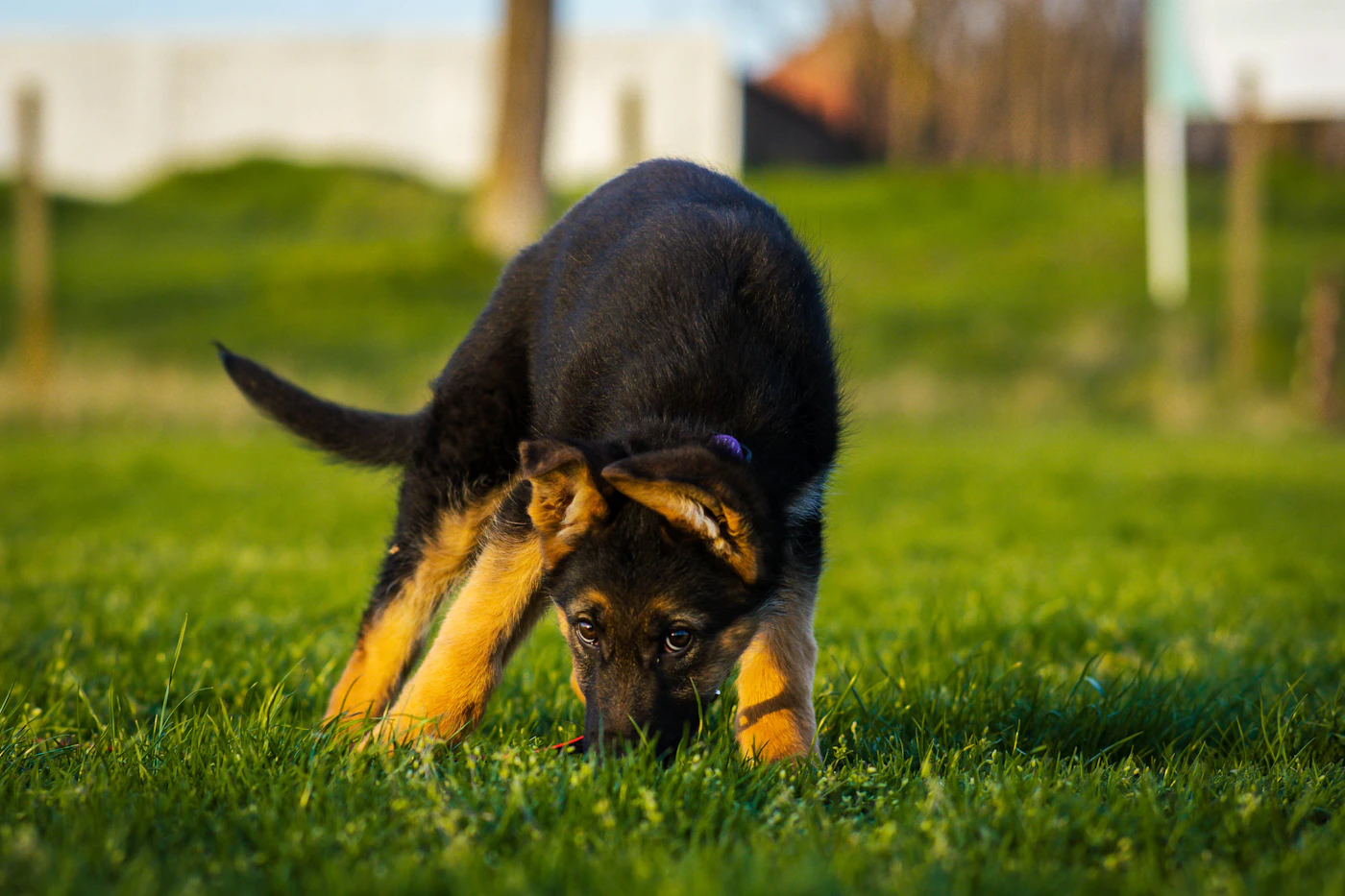
The dog follows a footstep track at a steady pace, nose in every print, and lies down at each article. Judges reward intensity, accuracy and calm.
- We track in the morning, on cut hay and grass fields across Parker County.
- Food-based foundation, then gradual fading so the dog tracks for the track itself.
- Article indication taught separately, then built into the track.
Phase B · Obedience
Precision thatlooks like joy.
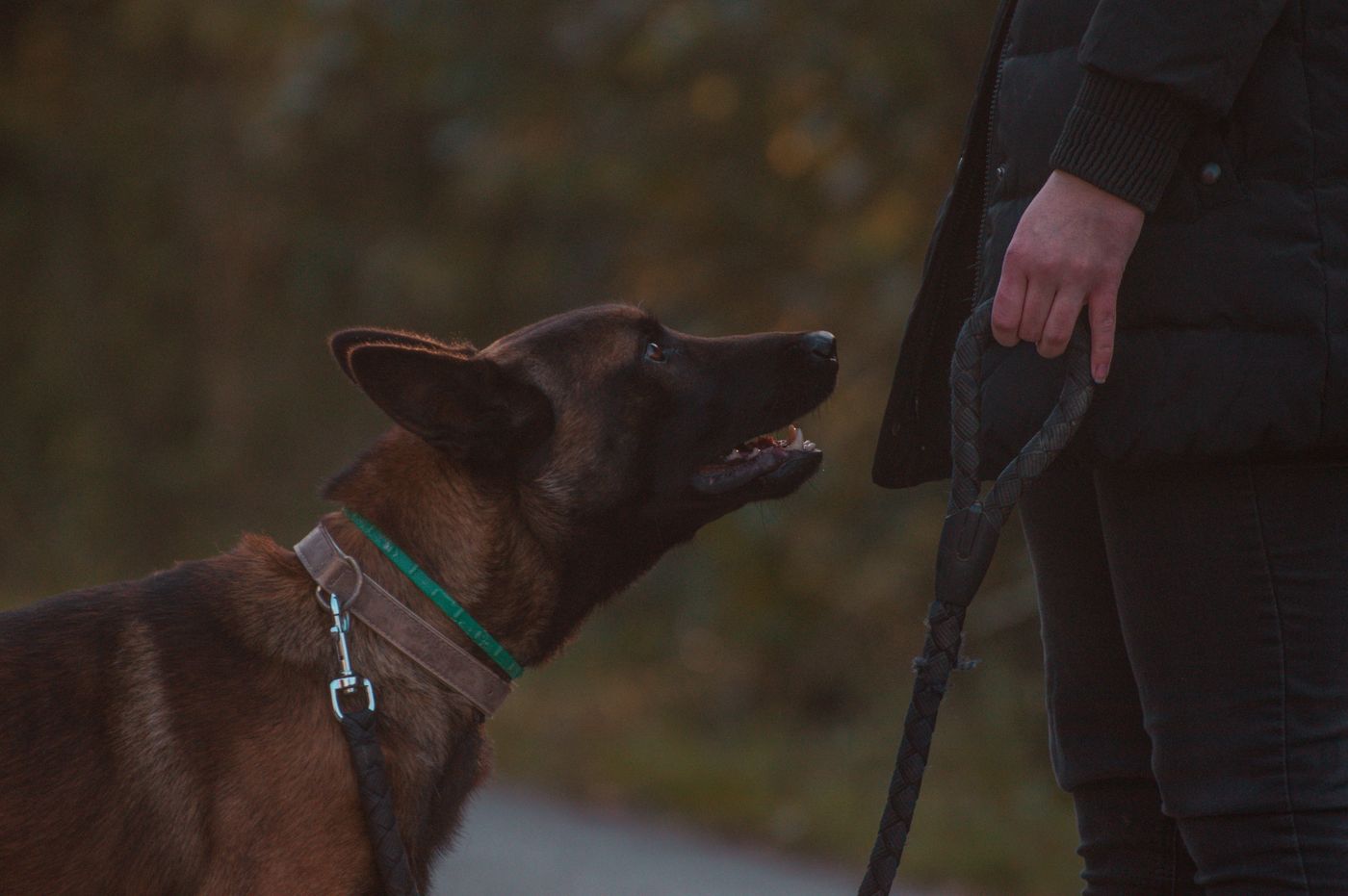
Heeling, positions out of motion, three retrieves, a send-out and a long down while another dog works. Points come from accuracy and from a dog that clearly wants to be there.
- Marker-based training with food and toys builds the picture first.
- Clear, fair corrections come only after the dog understands, and are always proportional.
- Trial-ready means working through crowd noise, gunfire and a strange field.

Phase C · Protection
Courage witha clean out.
The dog searches blinds, holds the helper with a loud, steady bark, and grips the sleeve full and calm when attacked. Then it lets go on one command. Control matters as much as courage.
- Grip foundation on rags and bite pillows before any sleeve work.
- Two certified helpers on staff who read dogs, not just catch them.
- The out is trained with clarity, never with conflict that breaks the grip.
Scoring
How a judgerates your dog.
Each phase is scored out of 100, for 300 total. A dog must score 70 in every phase to earn the title. The judge also rates the dog's grip, confidence and stress tolerance (TSB).
96–100
90–95.5
80–89.5
70–79.5
below 70
Where to trial
In the US, IGP trials run under the FCI international rules through clubs of the American Working Dog Federation (AWDF). German Shepherd handlers usually trial and breed-survey through USCA. Malinois handlers trial through AWMA and DVG America. Ironside is a DVG America member club, and our members trial at all three.
Step one
Every dog startswith an evaluation.
Ninety minutes on our field. We test drive, grip, environmental nerve and how your dog handles pressure, then tell you honestly what your dog is suited for.